
CARETRACE
Current focus. iOS on Apple Health: share and follow family, each on a personal baseline. Deterministic readiness, medical-domain language after the estimate, withheld when the record is thin. Not a diagnosis.


Advanced Engineering Lab is a research and development company. We study how much health inference a consumer record can support — EEG, heart, sleep, activity, and recovery — when the sensors are the ones people already wear.
Estimates are deterministic and inspectable. Medical-domain language models describe those estimates; they do not invent them. Current focus is CareTrace: an iOS system on Apple Health for sharing personal estimates with family, and following theirs.
Approach
Consumer devices return incomplete physiology: optical heart rate, staged sleep, dry EEG, wrist temperature. Those streams are useful only as far as their quality goes. The research problem is the estimator, not the dashboard.
Three constraints hold across the lab. Deviation is defined against the individual, not a population cutoff. Every channel carries a reliability term that enters the estimate arithmetically. And the claim is bounded by the record: when a stream is thin or absent, the output weakens or is withheld.
Language sits after inference. A medical-domain model may describe what the pipeline found. It does not decide whether a finding exists.
Sense
Consumer EEG, PPG, sleep, motion.
Estimate
Deterministic, person-specific.
Bound
Withhold when the record is thin.
Describe
Medical LLM after inference.
The research covers signals available on consumer sensing devices — Apple Watch and HealthKit for overnight HRV, resting heart rate, sleep, activity, and wrist temperature; dry EEG headsets for band power and state change; voice as a session-time adjunct. A consumer optical sensor is not a clinical ECG. A dry headset is not a clinical montage.
Those limits set the resolution of every downstream claim. Overnight HRV and resting heart rate carry more day-to-day information than a single daytime sample, so both are taken inside the sleep window. EEG band power is a spectral feature, not a measurement of focus, meditation, or comprehension.
Where a channel is saturated, flat, or dominated by muscle artifact, it is gated out — not smoothed in. Missing data is offered as a gap the person can fill. It is not interpolated into a confident score.
Research
The sensing layer is the consumer stack: HealthKit vitals and sleep, optical HRV, motion, and research-grade dry EEG. Processing is built around what those devices actually emit — sampling gaps, staging error, and optical artifact — rather than around a clinical-grade ideal.
Deviation is measured against the individual's own history. CareTrace uses a 28-day robust baseline (median and IQR spread), ready after about seven usable days, so a single outlier night does not redefine what is usual. Until the record can support a personal baseline, confidence is withheld rather than borrowed from a population norm. A shared family view does not pool those baselines.
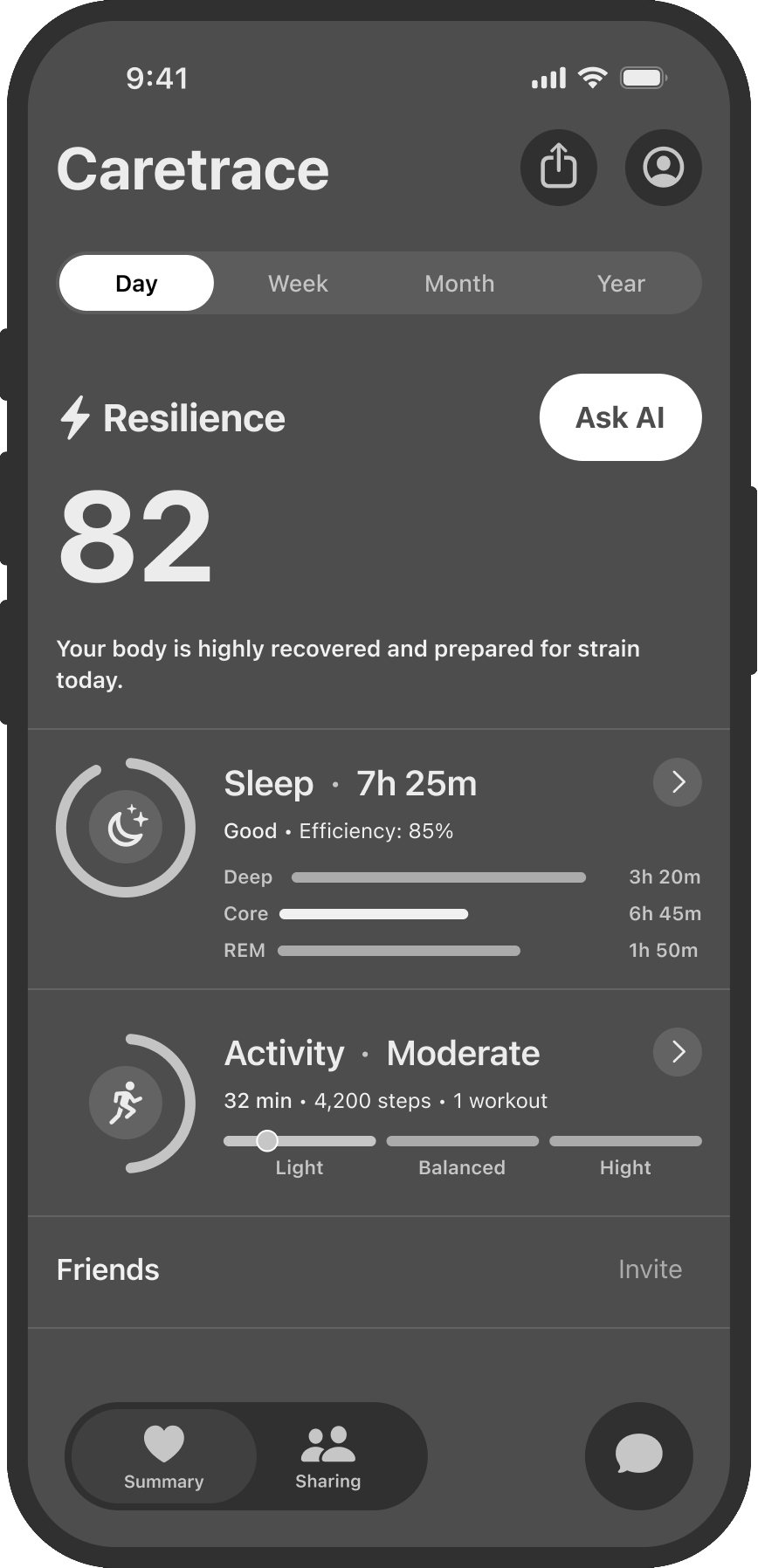
Readiness, concordance, missing-data offers, and condition-metric drift are rule-based and reproducible: identical inputs give an identical output over an inspectable path. CareTrace's on-device readiness combines sleep, overnight HRV, resting heart rate, and activity, and returns a band instead of a number when the record is only partial.
Each sensing branch emits a standardized estimate and a reliability weight. Degraded channels are attenuated, not dropped silently. Cross-modal disagreement is measured: when confidence is low or channels conflict, the system moves to a conservative mode instead of producing a confident number from conflicting evidence.
Language models describe estimates. They do not compute them. CareTrace uses a medical-domain LLM (MedGemma) over a deterministic spine — personal baselines, readiness, monthly cards, missing-data offers — so language narrates what the record already supports, not to invent a finding the estimator did not produce.
Omlab is the neural-interface line: EEG acquisition, artifact rejection, band-power features, and closed-loop BCI at session timescale. Fusion with HRV and voice is under investigation as a reliability-weighted state estimate, not as a decoded thought or a guaranteed intervention.
The same constraints are tested at two time scales. CareTrace — the current applied focus — operates across days on Apple Health: personal estimates a family shares and follows, on consumer wearables, where the record is thinner and the sensors are optical. Omlab operates on seconds inside a session, on EEG, HRV, and voice, where the intervention is part of the loop.
CareTrace is a family record built from personal baselines: share yours, follow theirs. Omlab is protocol and evaluation work on EEG and BCI.

EEG and BCI research. Closed-loop neuroadaptive sessions studied as state estimation: EEG, HRV, and voice fused under per-channel reliability. A methods protocol, not a claim of efficacy.
Current focus · share and follow
Follow family. Share yours. An iOS app on Apple Health: each person on their own baseline, how today differs, and the confidence on each signal.
Follow family members. Their estimates stay on their own baseline — a view of a personal record, not a household score.
Share your own. Readiness, withheld claims, and monthly cards travel with the person; nothing is merged.
Readiness from sleep, overnight HRV, resting heart rate, and activity — withheld when the record is thin.
A 28-day robust baseline. Monthly cards as the deterministic spine.
We use MedGemma to describe numbers already computed. Chat describes estimates. Not a medical device.
A score without provenance is not a measurement. 72 readiness, poor recovery, high stress — none of these state which channels contributed, how reliable they were, or what the record could not support.
So the pipeline carries its own telemetry: per-channel reliability, fusion confidence, cross-modal disagreement, and the reason an estimate was withheld. MedGemma sits on that telemetry as a description layer. It narrates what the estimator already produced; it does not decide whether a finding exists.
Which channels contributed, and at what reliability?
How large is the deviation from this individual's own baseline?
Is this claim backed by a computed estimate, or only by language?
What was the fusion confidence, and did the channels disagree?
What does the record not support?
What we do not claim
Diagnosis, treatment, or clinical efficacy.
That a consumer wearable is equivalent to a clinical instrument.
That EEG band power measures focus, meditation, or comprehension.
That a BCI decodes thought or guarantees an outcome.
That a language model may decide a physiological finding.
That literature-derived thresholds are prospectively validated here.
Stating the limit is not a disclaimer appended to the work. It is part of the result.
Collaboration
We collaborate on physiological signal processing, EEG and BCI methods, consumer-device validation, and estimation under degraded data — problems where measurement integrity determines what any model above it is permitted to say.
We are most interested in work that can state its evidence, its uncertainty, and its limits.
Contact the labThat is the research question. It is answered through consumer-device measurement, deterministic estimators that report their own uncertainty, and medical-domain language that describes the path from signal to claim.
Not through more dashboards, and not through letting a model decide the finding.
EEG and BCI research. Closed-loop neuroadaptive sessions studied as state estimation: EEG, HRV, and voice fused under per-channel reliability. A methods protocol, not a claim of efficacy.